The excerpts presented here are part of a larger research paper presented at the 2020 Georgia State Undergraduate Research Conference.
Digital Communication and Its Effect on the Cohesion of Collegiate Rowing Clubs
Introduction
Literature in the field of sports communication and psychology aptly examines the success of types of attitudes and relationships on sports teams in a wide variety of ways. Research has tracked and formulated the best way for coaches to talk to athletes, and how often, and coaches themselves can testify to the success of changing their communication styles. However, little research has been conducted on the way athletes and coaches communicate outside of their practice times and competitions, and there are gaps in the study of communication in smaller teams or clubs. While larger teams provide a larger data sample, and might be able to better correlate communication to success, examining smaller teams and clubs provides insight into how these proposed communication techniques fail. In my research I compared two collegiate rowing clubs, the Georgia State University Rowing Club, and the University of Georgia Rowing Club. The teams are different sizes, and have vastly different team cultures, and levels of success. I myself am on the Georgia State University team, so I hoped to learn techniques I could personally apply to my own communication through this research. In my research I sought to identify how the athletes on these teams are communicating with a focus on digital methods.
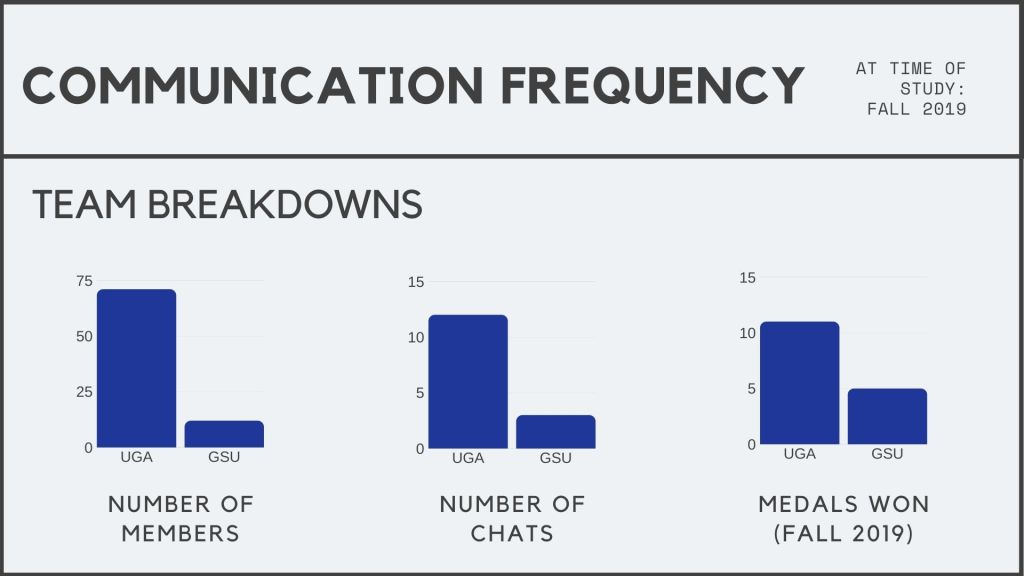
My research has a unique lens of looking at digital sports communication, as well as communication within a sport that is majority clubs and not school teams. This is an important distinction when factoring in success in comparison to the teams studied within the sports communication field. A Division I team where athletes and coaches have high access to resources such as specialized schedules, money, academic help, housing, alongside contractual obligation will have different problems from a club without any of these resources. While many of the concepts introduced by the literature of this field still apply, and are helpful for the two rowing clubs, the struggles clubs like these have are not factored into the research that is widely conducted. My research will take the literature of this field and implement it outside of its original framework.
Literature Review
Rowing is a team sport that falls somewhere in between coactive and interactive, as defined by Jones and Kijeski (2009). In their research in the correlation between team cohesion and sport performance, it was necessary to make this distinction because the effect of close coach-player ties had different results depending on the type of sport. In a coactive sport, where the individual can be judged both separate and with the team, such as track, gymnastics, or tennis, surprisingly, a negative correlation was found between team success and the strength of coach-player relationships. However, both interactive and coactive sports found correlation between team cohesion and team success, where team cohesion is measured by an individual’s perception of the team working well together. In rowing, a team is judged by a whole for team points to win regatta trophies, and individual boats are also judged, but not the individuals within the boats. That is to say, one (or several) boats can do poorly and a team may still win team points, but an individual within a boat cannot do poorly and that boat still win– it falls somewhere between coactive and interactive.
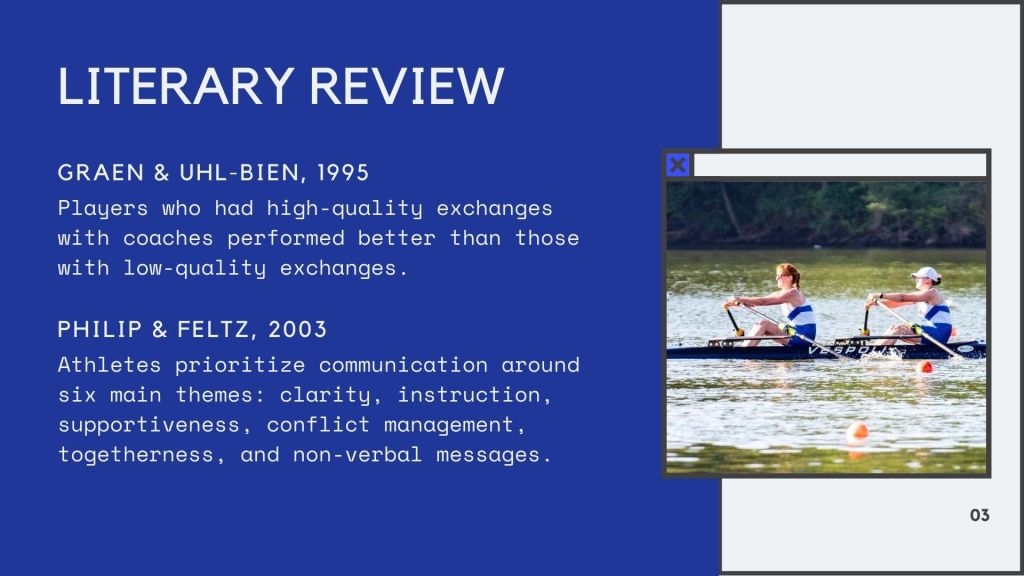
In interactive and coactive teams, problems can arise when the quality of exchanges is different between coaches and different players. Players who had high-quality exchanges with coaches that were based in trust, respect, and obligation performed better than those with low-quality exchanges (Graen & Uhl-Bien, 1995). In a large team, it is difficult for a coach to have many high-quality exchanges, my research shows that this high-quality exchange “in-group” also develops on small team even when coaches seemingly have the necessary resources to have high-quality exchanges with many members.
However, Philip and Feltz found that the player-player communication was more important than “Leader-Member Exchange,” or exchanges with coaches (Graen, 2003). In their research interviewing 157 athletes across seven sports, they found athletes themselves prioritized communication around six main themes: clarity, instruction, supportiveness, conflict management, togetherness, and non-verbal messages (Philip & Feltz, 2003). The themes they identified here are present within my own research, and their importance is emphasized as the differences between the crews of Georgia State University and the University of Georgia become more clear, specifically in the themes of togetherness and clarity.
Both schools struggle with some level of cohesion. It is important to note that it has been found that women’s sports team have overall better cohesion than men’s sports teams, and in my research I interviewed men from both teams (Jones & Kijeski, 2009). The differences in women’s and men’s club rowing is important to factor in, because many of the elite women’s teams are Division I, and therefore don’t compete against women’s clubs teams. This makes it somewhat easier to succeed as a woman on a club team, whereas elite men’s rowers are often competing within the same category as club men’s rowers. At the time of the interviews, both teams had struggled to recruit men that year, and has a smaller men’s team in comparison to their school’s women’s team. McEwan and Beauchamp situate problems that both of these teams experience within the work. For example, a larger team may have more funding, and so they can hire better coaches which may have a positive effect on performance. However, in order to have more funding, a team may first require more people, which can be difficult to recruit without good coaches (McEwan & Beauchamp, 2014). These factors are defined as inputs, which are affected by mediators to create outcomes. Each team has different inputs and mediators, and by manipulating these categories different outcomes can be observed. An important distinction to make, as it is different within each of these studies, is my research’s working definition for team cohesion for my own research. For the purposes of this paper, I will use McLaren and Spink’s definition to mean “the tendency for a group to stick together and remain united in pursuit of its instrumental objectives and/or for the satisfaction of member affective needs” (2014). This definition over others is useful because it does not emphasize the role of competition results, which for the purpose of this paper will not be heavily considered.
While some literature in this paper comes from journals published as recently as 2018, the majority of the research conducted here came before the creation of “GroupMe” which both teams use to communicate. All of these studies focus on the importance of verbal, face-to-face communication, which it rightfully important, but in a culture of college students, eliminates much of the communication that goes on outside of practice, and between athletes personally. NCAA rugby coach Becky Carlson writes on her experience encouraging player dialogue on and off “the field” in her case . Like Philip and Feltz, Carlson knows that dialogue between players is necessary for cohesion and success, and is one of the main differences between the school’s in my research. My research takes on the fundamentals of previous studies, but views them through a technological lens where communication happens digitally and not in person.
Works Cited
Graen, George B., and Mary Uhl-Bien. “Relationship-Based Approach to Leadership: Development of Leader-Member Exchange (LMX) Theory of Leadership over 25 Years: Applying a Multi-Level Multi-Domain Perspective.” The Leadership Quarterly, vol. 6, no. 2, 1995, pp. 219–247., doi:10.1016/1048-9843(95)90036-5.
Jones, Amy, and Ted Kijeski. “The Relationship of Team Cohesion on Performance among Collegiate Athletic Teams Competing in Coactive Team Sports.” Conference Papers — National Communication Association, Jan. 2009, p. 1. EBSCOhost, search.ebscohost.com/login.aspx?direct=true&AuthType=ip,shib&db=ufh&AN=54434994&site=eds-live&scope=site.
McLaren, Colin D., and Kevin S. Spink. “Examining Communication as Information Exchange as a Predictor of Task Cohesion in Sport Teams.” International Journal of Sport Communication, vol. 11, no. 2, June 2018, pp. 149–162. EBSCOhost
Sullivan, Philip, and Deborah L. Feltz. “The Preliminary Development of the Scale for Effective Communication in Team Sports (SECTS).” Journal of Applied Social Psychology, vol. 33, no. 8, Aug. 2003, pp. 1693–1715. EBSCOhost, doi:10.1111/j.1559-1816.2003.tb01970.x.
 Anna Reuter
Leave a comment